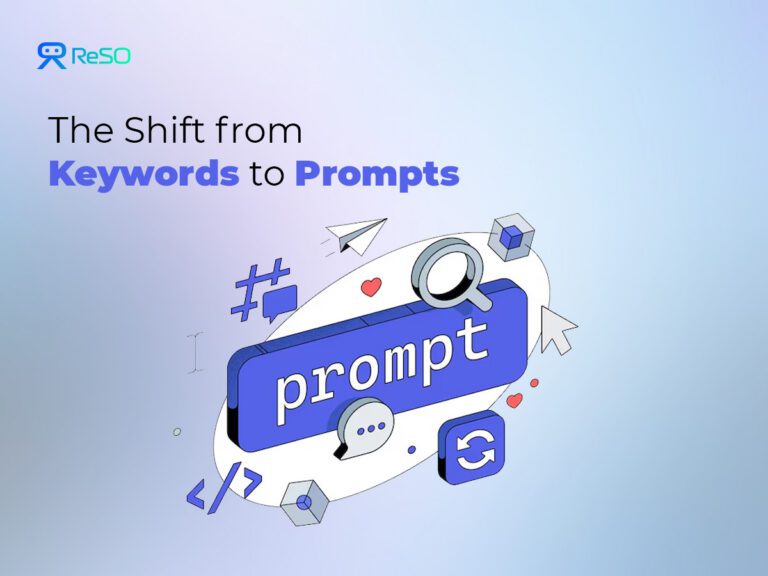




Keyword-first marketing is losing its grip. As AI discovery grows, users aren’t typing short, rigid phrases anymore. Gartner’s data and industry trends all point to the same pattern: search volume is flattening because people now expect answers, not links.
Instead of “best payroll software,” buyers ask questions that reflect their real situations: “Which global payroll tool works for a 50-person remote team?” These richer prompts carry intent, context, constraints, and goals; signals keywords were never built to capture.
This is the new reality: Search engines rank pages. Generative engines assemble answers.
And in this shift, the brands that show up are the ones that make sense inside the model’s understanding of a category, not the ones chasing only the legacy keyword volume.
Why Keyword Research No Longer Reflects How Buyers Search
Keyword research was designed for short, typed queries. Metrics like search volume and keyword difficulty work when users repeat the same predictable phrases. However, as more discovery moves into AI systems, these metrics reveal only a small part of how people now express intent.
Real AI prompts vary by situation. A buyer might ask, “How do global teams manage payroll accuracy across 12 countries?”, a question carrying intent, constraints, persona, and expected outcomes. Traditional tools can’t interpret that level of detail because they’re still analysing fragments instead of conversations.
This is where Prompt-Level SEO becomes useful.
- It helps you understand the real questions buyers ask inside ChatGPT, Claude, Perplexity, and other generative systems.
- Instead of relying only on keyword research, you examine how prompts form patterns, how context shifts meaning, and how LLMs assemble answers.
- This is closer to lightweight LLM research than traditional keyword analysis because the focus is on how models interpret information, not how users type it.
- A quick distinction: prompt engineering helps you communicate with an LLM. Prompt intelligence helps you understand how buyers communicate through LLMs. This includes the full spectrum of AI writing prompts that appear across support queries, sales calls, Reddit threads, review sites, and chatbots.
- Prompt-level optimisation aligns your content with how people naturally ask questions today. It’s also reshaping what an AI search visibility tool needs to measure, because visibility now depends on understanding intent patterns, not only ranking signals.
Where Real Prompts Come From (and How to Collect Them)
Real buyer prompts don’t appear in keyword tools. They show up in the places where people describe their goals, frustrations, and scenarios in their own words. These sources reveal the questions buyers actually ask, not the simplified terms they once typed.
| Source | What It Reveals |
| Raw, unfiltered prompts from industry threads, founder discussions, comparisons, and problem-solving conversations. | |
| G2, Capterra, Gartner Peer Insights | Use cases, challenges, evaluation criteria, and the questions buyers ask while comparing products. |
| Sales & Demo Call Transcripts | What prospects want to achieve, what’s blocking them, and the exact phrasing of high-intent prompts. |
| ChatGPT / Claude / Perplexity Logs | How users naturally phrase an AI prompt when exploring solutions or testing ideas. |
| Support Tickets & In-Product Search | Specific issues, context-rich situations, and repeatable question patterns that influence future LLM answers. |
Once gathered, prompts can be grouped into practical buckets to understand intent patterns:
- Informational: learning how something works
- Commercial: comparing options or vendors
- Transactional: ready to buy or implement
- Scenario-based: tied to a specific situation, role, or constraint
These clusters become the backbone of prompt-level optimisation because they reflect how real buyers think before an LLM assembles its answer.
How LLMs Interpret and Cluster Prompts
When someone asks an AI system a question, the model doesn’t just look at the words. It breaks the prompt into components that help it understand what the user wants and how to assemble an answer that feels complete.
LLMs pick up on elements such as:
| Signal | What It Captures |
| Entities | Brands, categories, countries, roles, or tools referenced in the question. |
| Intent | Whether the user wants to learn, compare, choose, fix, evaluate, or decide. |
| Constraints | Team size, budget, timeline, geography, compliance needs, or technical limits. |
| Persona | The implied role behind the question (founder, HR manager, finance lead, compliance head). |
| Relationships | How entities or variables connect or influence each other in the prompt. |
| Desired Outcomes | What the user wants to achieve (e.g., reduce errors, expand to new markets, lower costs). |
Once extracted, the model groups similar prompts into clusters. These clusters are not based on keywords; they’re shaped by intent and context.
A cluster might include prompts about comparing customer success platforms, evaluating SOC 2-ready analytics tools, choosing an AI writing assistant for enterprise workflows, or solving issues in multi-region data sync.
These prompt clusters help the model build its understanding of a category. When it assembles an answer, it relies on patterns that appear across many similar prompts, not on a single phrase or keyword.
This makes prompt-cluster analysis essential. It reveals how the model maps a market, which brands feel most relevant inside each cluster, and which sources shape the associations that influence whether a brand appears in an AI-generated answer.
Why Prompt Patterns Matter More Than Search Volume
Search volume and keyword difficulty measure how often people typed specific terms, not how they now express intent through AI systems.
Prompt patterns show what buyers are trying to achieve, the context behind their decisions, and the scenarios that shape how LLMs assemble answers. LLMs prioritise prompts that offer enough detail to generate a confident, context-aware response.
The signals that matter for visibility inside AI answers include:
- Interpretability: how clearly the model can understand your product’s purpose and positioning.
- Contextual depth: whether your content addresses real scenarios, use cases, and decision criteria.
- Entity clarity: how consistently your brand and product attributes appear across trusted sources.
- Citation authority: which domains reference your brand and how often those domains influence AI responses.
- Co-occurrence patterns: how frequently your brand appears alongside competitors, category terms, and related concepts.
New AISO-forward metrics emerging from prompt behaviour:
- Intent density: the richness and specificity of prompts within your category.
- Answer likelihood: how often the model selects certain brands or sources when forming responses.
Prompt patterns uncover category demand more accurately than keyword lists because they reflect how buyers think when interacting with AI systems.
Prompt-Level SEO as a Core Discipline
Discovery is shifting toward dialog-driven exploration. Buyers test ideas, compare options, and evaluate vendors through natural language, not pre-defined keyword structures. Every question adds a new signal to how an LLM interprets a category.
As AI-generated answers become a primary distribution layer, visibility depends on how well a brand fits into the model’s understanding of the category. Companies that study prompt patterns, strengthen their entity signals, and build content aligned with trusted sources gain a consistent presence across generative engines.
Prompt-Level SEO turns this behaviour into a repeatable system: track prompts, cluster intent, map citations, improve entity clarity, and measure how often the model selects your brand when assembling responses.
Keywords capture interest. Prompts reveal real buying intent.
ReSO helps teams work with this new reality. It uncovers the prompt clusters shaping your category, identifies which sources LLMs trust, highlights the gaps in your citation footprint, and shows how your entity signals appear across generative engines. You get a clear view of what the model understands and what it doesn’t.Book a call →
Explore how ReSO can strengthen your AI visibility foundation.