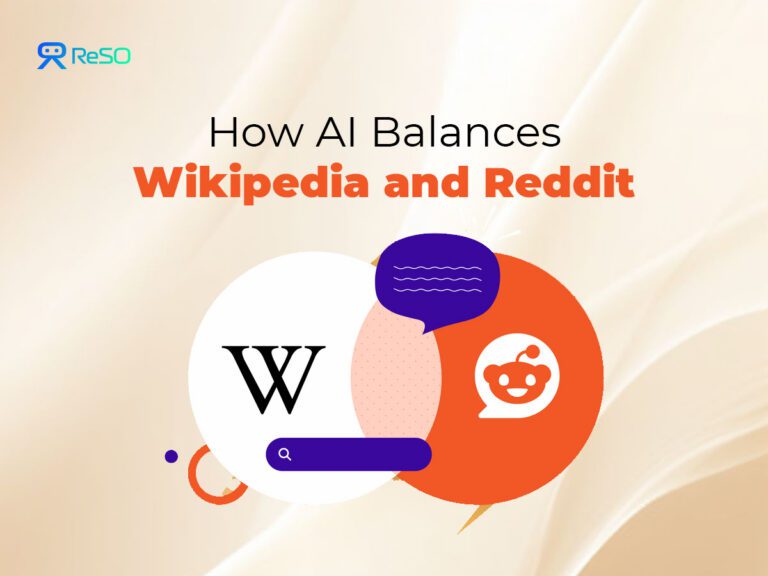



AI systems don’t treat all sources equally. When you ask ChatGPT a factual question, it leans heavily on Wikipedia. When you ask Perplexity for product recommendations, it pulls from Reddit.
A 2025 study of 150,000 AI citations found Reddit accounts for 40.1% of all LLM references, outpacing Wikipedia at 26.3%. AI platforms make deliberate design choices about what constitutes authoritative information. Understanding these choices determines whether your content gets cited or ignored.
What’s the Difference Between Structured and Lived Information?
Structured truth
- Refers to curated, editorially-reviewed content with clear sourcing and organizational hierarchy.
- Wikipedia, government databases, scientific journals, and Schema.org-marked web pages fall into this category.
- These sources prioritize verifiability and factual accuracy.
Lived experience
- Captures how people actually encounter problems, evaluate solutions, and share outcomes.
- Reddit threads, Quora answers, forum discussions, and customer reviews represent this category.
- These sources prioritize authenticity and practical insight.
Both matter because different questions demand different types of authority.
- “What is photosynthesis?” requires structured truth.
- “What’s it actually like to use Notion for project management?” requires lived experience from people who’ve debugged integrations at 2 am.
Why Do Different AI Platforms Cite Different Sources?
The citation patterns across major AI platforms show dramatically different design philosophies:
| Platform | Wikipedia | Primary Use Case | |
|---|---|---|---|
| ChatGPT | 47.9% | Low | Factual queries, definitions |
| Perplexity | 2% | 46.7% | Product research, recommendations |
| Google AI Overviews | 5.7% | 21% | Balanced, intent-dependent |
ChatGPT’s Wikipedia preference signals a commitment to verifiable facts. When OpenAI “flipped a switch” in November 2024, Wikipedia citations jumped from near-zero to 13% overnight. Platform operators can redirect billions of citations through ranking adjustments.
Perplexity’s Reddit dominance reflects its positioning as an “answer engine” for subjective queries. When users ask for product comparisons or “what’s it like” questions, Perplexity assumes community consensus matters more than encyclopedic definitions.
Google AI Overviews take a hybrid approach to source authority. They prioritize structured sources like Wikipedia, while selectively incorporating community signals when user intent shifts toward evaluation or comparison.
When Does AI Prefer Structured Sources?
AI systems employ query classification to determine source selection before generating responses.
Structured data dominates for:
- Definitional queries – “What is machine learning?” defaults to Wikipedia-style encyclopedic answers
- Entity information – Queries about people, companies, or products leverage knowledge graphs and Schema.org markup
- Technical specifications – Product features, prices, and measurements come from structured e-commerce data
- Historical facts – Dates, events, and timelines pulled from editorially curated sources
A head-to-head experiment found that pages with Schema.org markup appeared in Google AI Overviews while identical pages without structured data did not. The structured version also ranked for six keywords in traditional search.
When Does AI Prefer Community Sources?
Lived experience wins for:
- Product recommendations – “Best project management tools for small teams” triggers Reddit discussions over product specs
- Subjective experiences – “How difficult is learning Python?” rely on firsthand accounts
- Troubleshooting – Technical problems surface in Stack Overflow threads and practitioner blog posts
- Real-time information – Breaking news and emerging trends favor recent community discussions
The data confirms this: 76% of high-intent SaaS searches surface Reddit threads in Google’s top 5 results. Brands with strong Reddit presence (Notion, Trello, Slack) appear consistently in AI recommendations across platforms.
How Do AI Systems Handle Conflicting Information?
When Wikipedia states one position and Reddit threads assert another, AI systems resolve contradictions through:
- Source authority weighting – Favoring established institutions over anonymous contributors
- Recency signals – Privileging newer information over potentially outdated facts
- Consensus aggregation – Surfacing majority community opinion
None of these heuristics guarantees accuracy. Each introduces systematic biases.
Hallucination risk varies by source type. A study found that nearly two-thirds of AI-generated academic citations were fabricated, with fabrication rates jumping from 6% for well-documented topics to 29% for obscure subjects.
- Wikipedia offers editorial oversight but can lag current events.
- Reddit provides real-time insight but lacks fact-checking.
What Does This Mean for Content Strategy?
Understanding AI source preferences creates actionable opportunities.
Build Structured Authority (15-Minute Quick Win)
- Audit your homepage for Schema.org Organization markup
- Verify your Google Business Profile matches website NAP data
- Check if your brand appears in Wikidata or Google’s Knowledge Graph
Cultivate Community Presence (Ongoing)
| Action | Why it matters |
|---|---|
| Participate authentically in relevant subreddits | Redditors detect and reject astroturfing |
| Monitor brand mentions for sentiment | Negative sentiment directly impacts AI responses |
| Encourage organic customer advocacy | User-generated content creates compounding visibility |
Establish E-E-A-T Signals
The Experience, Expertise, Authoritativeness, Trustworthiness framework now influences AI platforms beyond just Google Search. Key signals include:
- Original research – Publish data and insights that can’t be found elsewhere
- Third-party validation – Earn mentions in reputable publications
- Expert recognition – Build thought leaders with verified credentials
- Cross-channel consistency – Ensure messaging aligns across all platforms
The Transparency Problem
AI platforms do not give users control over how answers are sourced. There is no way to tell an AI system to prefer expert research over community opinion, or lived experience over institutional authority, even though different questions clearly require different forms of evidence.
At best, platforms offer post-hoc disclosure. Perplexity shows which URLs were used after an answer is generated, but users cannot influence source weighting beforehand or see how conflicts were resolved. These decisions live inside opaque retrieval and ranking layers that change frequently.
This opacity matters because AI systems now act as curators of truth, not just retrievers of information. When platforms adjust source preferences, they can redirect billions of citations overnight. Authority stops being an emergent outcome of consensus and becomes a product of platform design. For brands and creators, visibility increasingly depends on understanding these hidden mechanics, not just producing accurate content.
What Does This Mean for Your Brand’s AI Visibility?
Understanding AI source preferences exposes a critical gap in most content strategies: brands optimize for traditional search while remaining invisible to AI systems.
The Dual Authority Problem
Your brand needs both types of authority to appear consistently in AI responses:
| Authority Type | What AI Looks For | Where It Lives |
|---|---|---|
| Structured | Schema markup, knowledge graphs, verified entities | Your website, Wikidata, and Google Business Profile |
| Experiential | Authentic discussions, user sentiment, community consensus | Reddit, forums, review platforms |
Most brands have gaps in one or both. They’ve invested in SEO but haven’t built Schema markup. They have customers who love them, but no presence in community discussions where AI sources recommendations.
The Visibility Blindspot
You can’t optimize what you can’t measure.
Traditional analytics show website traffic and search rankings. They don’t show whether ChatGPT mentions your brand when someone asks for product recommendations. They don’t show how Perplexity characterizes your company when pulling from Reddit threads. They don’t track the sentiment AI systems associate with your brand across millions of daily queries.
How ReSO Shows You What AI Sees
ReSO provides visibility into how AI systems perceive and represent your brand across ChatGPT, Perplexity, Gemini, and other LLM-powered platforms.
What ReSO shows you:
- Which AI platforms cite your brand (and which don’t)
- What sources do AI systems pull when discussing your category
- How your brand sentiment compares to competitors in AI responses
- Gaps between your structured data presence and community authority
Instead of guessing whether your Schema markup matters or wondering if Reddit discussions help or hurt your AI visibility, ReSO shows you exactly where you stand and what to fix.
What Now?
AI systems aren’t choosing sources randomly. Every citation reflects deliberate design choices about what constitutes reliable information for specific query types.
For anyone creating content:
- Factual authority requires structured data, Schema markup, and presence in knowledge graphs
- Experiential authority requires authentic community engagement where real users discuss your product
- Complete visibility requires both, because different queries trigger different source hierarchies
Some questions demand encyclopedic precision. Others require human judgment. Organizations that build for both will shape how buyers discover solutions. Those who don’t will keep wondering why competitors get recommended.
Book a call with ReSO and search your brand name in ChatGPT, Perplexity, and Google AI Overviews. Compare what sources get cited. The gaps show where your authority needs work.