“Google is increasingly a destination, not a conduit to other websites.”
– Rand Fishkin, Founder of Moz & SparkToro
For years, we treated clicks as proof that marketing was working. More traffic meant more influence. Fewer visits meant something was broken.
That logic doesn’t hold anymore.
Today, most buying decisions are shaped before anyone visits your site.
- Search results explain answers directly.
- AI tools summarise options.
- Comparison pages highlight winners.
- Reviews and community opinions build trust early.
By the time someone clicks, they’re usually not exploring. They’re confirming.
Zero clicks is a misleading term because it sounds like nothing happened. In reality, everything important already has: judgment, shortlisting, and trust are formed outside your website.
Influence hasn’t disappeared. It has just moved upstream.
Why “Zero Clicks” Doesn’t Mean Zero Influence
Search engines and AI systems are no longer gateways. They are decision surfaces. When someone searches today, they’re not always looking to browse. They’re looking for clarity, and the interface gives it to them.
Users absorb explanations directly on the results page.
- They read AI-generated summaries.
- They scan comparisons, ratings, and shortlists.
- They decide what feels credible and what doesn’t.
All of this happens before a click, and often instead of one. Influence doesn’t come from traffic anymore. It comes from presence:
- How often does your brand show up
- How it’s described
- The context it appears in
- Whether it’s included at all
Zero-click doesn’t mean zero impact. It means influence is happening off-site, in places most analytics don’t track. Once you accept that decisions are happening outside your website, the real question changes:
If influence isn’t happening on your site, where exactly is it showing up?
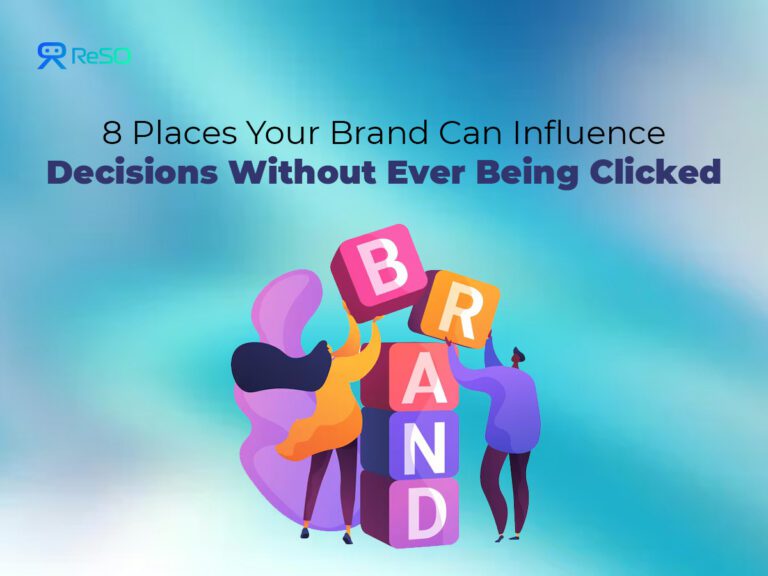
The 8 Places Your Brand Shapes Decisions Without a Click
The influence is happening across the interfaces people use to decide. These are the places where perception is formed, trust is built, and shortlists are created, often without a single visit.
1. AI Summaries & Answer Engines
(ChatGPT, Gemini, Copilot, Perplexity)
- When someone asks AI to explain a category, compare tools, or recommend “the best options,” the answer often becomes their starting point, and sometimes their conclusion.
- Influence here comes from being included, quoted, or referenced. Not from links.
- If AI consistently mentions your brand while explaining the problem space, you stay in consideration. If it doesn’t, your brand quietly disappears from the conversation.
- Omission is the most expensive outcome in AI answers, because users rarely notice what’s missing.
2. Search Result Explanations
(Featured Snippets & AI Overviews)
- Many users no longer treat search results as a list of links. They treat them as the answer. Featured snippets, AI overviews, and expanded explanations now explain topics directly on the results page, often removing the need to click at all.
- This is where framing happens. When a search result explains what a product does, who it’s for, or how options differ, that explanation becomes the reference point users carry forward. It shapes expectations before any brand interaction begins.
- If competitors’ language, outdated assumptions, or generic descriptions dominate these explanations, that framing sticks. Even if users later visit your site, they arrive with a story already written.
Position matters less than representation. Being visible but misrepresented can be worse than not appearing at all.
3. Comparison Tables & “Best Of” Lists
Most buyers don’t read comparison pages line by line. They scan.
Tables, shortlists, and “best tools for…” lists are designed for fast elimination. A quick look at names, categories, and one-line descriptions is often enough for someone to decide what’s worth deeper attention.
Influence here comes from how you’re positioned, not just where you rank.
- The label next to your brand matters.
- So does the category you’re placed in.
- So does who you’re compared against.
Being described as “enterprise-ready,” “budget-friendly,” or “best for startups” quietly shapes who considers you and who doesn’t. Even when users don’t click through, those descriptors stay.
4. Review Aggregators & Rating Summaries
- Star ratings, sentiment labels, and “what users like most” sections act as shortcuts to trust. These summaries often decide whether a product feels safe to explore or easy to ignore.
- Increasingly, AI systems compress hundreds of reviews into a single narrative. A few recurring themes become the story: reliability, support quality, ease of use, and value for money.
- Even without clicking into individual reviews, buyers walk away with a clear impression. If the summary feels positive and consistent, trust builds early. If it feels mixed or unclear, hesitation sets in long before deeper research begins.
By the time someone visits your site, this narrative is already in their head.
5. Brand Mentions Across the Web (Without Links)
Brands are mentioned every day in industry reports, analyst briefings, newsletters, podcasts, and market commentary, often without a clickable URL attached. To a human reader, these mentions feel casual. To AI systems, they are strong signals of relevance and authority.
LLMs don’t rely only on links to understand which brands matter. They look for repeated contextual mentions across trusted sources. A company referenced consistently in fintech reports, SaaS newsletters, and industry podcasts becomes part of the category narrative, even if no one ever clicks through.
This kind of visibility compounds quietly. No click. No session. No attribution.
Yet these mentions influence how often your brand is recalled, referenced, and recommended when AI systems generate answers later.
6. Community Discussions & Peer Answers
(Reddit, Quora, Slack communities, Discords)
When buyers want honest answers, they don’t start with brand websites. They ask other people.
- Community threads, peer responses, and first-hand experiences shape perception in a way marketing content can’t.
- These conversations answer the questions buyers are hesitant to ask publicly: what actually works, what breaks, and what to avoid.
- AI systems pay close attention to this layer. They ingest these discussions as lived experience, using them to balance official claims with real-world feedback.
- When your brand is spoken about positively, repeatedly, and naturally in these spaces, trust builds. When it’s missing or criticised, that absence or sentiment travels far beyond the original thread.
7. Visual Search & Image Results
Not all understanding comes from text.
Charts, diagrams, screenshots, and product visuals increasingly appear in search results, AI answers, and comparison carousels. In many cases, the image communicates value faster than a paragraph ever could.
Users don’t study these visuals. They interpret them.
- A clear product screenshot can signal maturity.
- A simple comparison chart can imply transparency.
- A messy or generic image can quietly reduce trust.
AI systems also use visuals to reinforce explanations. When images are pulled into summaries or result panels, they shape how a product or category is perceived
8. The Familiarity Effect Across Interfaces
(Repeated Exposure)
Influence rarely comes from a single moment. It comes from familiarity.
- Seeing the same brand name across AI answers, search explanations, comparison lists, reviews, and community discussions creates a sense of legitimacy. Even without engagement, repetition signals relevance.
- Users may not remember where they saw you first. They just recognise you. This recognition reduces friction. It makes a brand feel established, safer, and easier to choose.
- By the time a click finally happens, the decision often feels obvious rather than risky.
- In this environment, traffic isn’t the starting point of the journey. It’s the byproduct of influence that’s already been built elsewhere.
Why Traditional Analytics Misses All of This
Most analytics systems were built for a different internet. They assume that influence starts with a click, continues on a website, and ends with a conversion. That model worked when search engines acted as gateways and attention flowed predictably through pages.
That’s no longer how decisions happen.
- When users get answers directly from search results, AI summaries, comparison lists, and review narratives, there is no session to record.
- GA4 doesn’t capture brand exposure inside an AI answer. Attribution models can’t see perception being formed on a results page or inside a summary.
- As a result, teams mistake invisible influence for no impact.
- Channels that shape consideration appear underperforming because they don’t drive traffic. Budget gets pulled. Effort gets reduced.
- Meanwhile, those same channels continue influencing buyers, just without showing up in dashboards.
- This measurement gap leads teams to optimise what’s easy to count, not what actually drives decisions.
Traffic is no longer the start of the funnel. It’s often the confirmation step. Optimising for this reality means focusing on presence, clarity, and trust across the full decision environment, not just your website.
This is what AISO is really about: ensuring your brand is understood, included, and remembered wherever decisions are being made.
For teams navigating AI search, zero-click behaviour, and off-site influence, explore ReSO’s resources to understand how visibility actually works now.