If you spend even ten minutes scrolling LinkedIn, Reddit, or a Slack channel with marketers in it, you’ll see the same thing happening over and over.
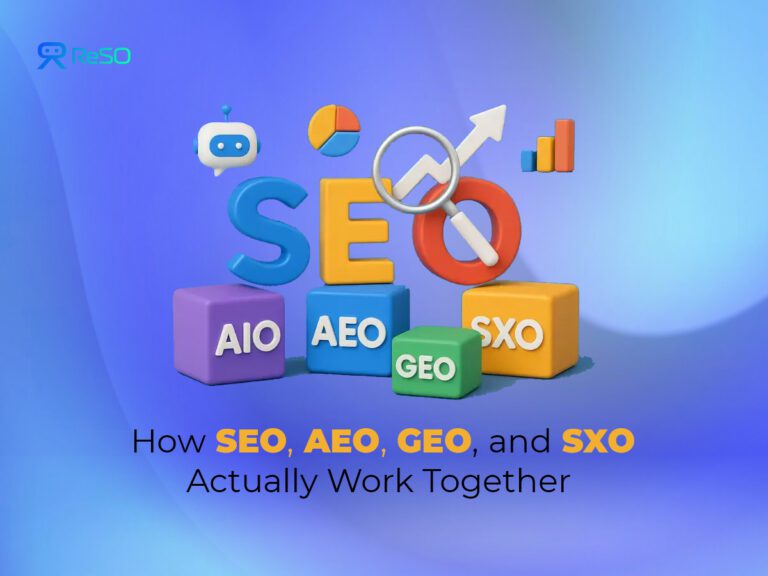
Someone mentions SEO. Someone else replies with AEO. Then GEO, SXO, and finally AISO enter the chat. At that point, most people have one of two reactions:
Reaction 1: “This is just SEO with new names.”
Reaction 2: “I should probably care about this… but I don’t even know where to start.”
Both reactions are completely understandable. Because from the outside, it does look like the industry suddenly decided to rename the same thing five different ways. However, that assumption is exactly what’s causing so much confusion right now.
This blog is not another acronym glossary. You won’t find long definitions or theoretical frameworks here.
Instead, we’ll break this down in the simplest possible way:
- What each discipline actually does
- Why do none of them work in isolation anymore
- And how together they form something bigger, what we call AISO
Why These Terms Exist in the First Place
To understand why SEO, AEO, GEO, and SXO exist, you have to look at what actually changed in search. It wasn’t just a new interface. It was a new process.
For a long time, search worked like this: Pages → rankings → clicks
- You created a page.
- Google ranked it.
- Users clicked and decided what to do next.
Today, the flow looks more like this: Sources → answers → decisions
AI systems don’t simply list pages. They collect information from multiple sources, combine it, and present an answer directly.
This single shift explains why new disciplines emerged.
- The problem is no longer just “How do I rank?”
- The real questions are:
- Can AI find my content at all?
- Can it understand what I’m saying?
- Will it trust me enough to include me?
- And if a human reaches me, will they believe me?
SEO, AEO, GEO, and SXO each exist to solve one of these specific problems. They’re not buzzwords; they’re responses to the way AI now creates answers.
What Each Discipline Actually Does
Each of these disciplines has one clear job. Not overlapping. Not abstract. One responsibility in the AI search journey. Once you see that, the acronyms stop blurring together.
SEO (Search Engine Optimisation)
SEO is the foundation. Nothing works without it.
Its job is simple: Make sure your content exists in places AI systems can access and trust.
That means:
- Your pages are crawlable and indexable
- Your site structure makes sense
- Your content is discoverable and technically sound
- Your domain earns baseline trust
If SEO fails, everything else fails. AI can’t quote, understand, or include content it can’t find.
SEO answers the first and most basic question: “Is this source even available to use?”
AEO (Answer Engine Optimisation)
AEO starts where SEO stops. It focuses on clarity, not keywords and is about:
- Clear definitions
- Direct answers to real questions
- Simple language without ambiguity
- Logical structure that AI can extract from
If your content reads well to humans but confuses machines, AEO is missing.
AEO answers this question: “Does AI know exactly what this page is trying to say?”
GEO (Generative Engine Optimisation)
GEO is where visibility changes shape.
AI doesn’t rank pages when it generates answers. It selects sources. GEO focuses on whether your content is chosen when AI builds a response. This is not about being #1. It’s about being reliable enough to be included.
GEO is influenced by:
- How consistently does your content answer questions
- How trustworthy your source appears
- How often does AI see your content as a reference point
This is where “visibility without clicks” begins.
GEO answers the question: “Will AI actually use my content when answering?”
SXO (Search Experience Optimisation)
SXO comes into play once a human reaches you, often because of AI.
Even in AI-driven journeys, people still check sources. They still scan pages. They still decide whether to trust you.
SXO ensures that:
- Pages load fast
- Layouts are clear and readable
- Messaging is consistent and confident
- The experience feels credible
If users bounce, hesitate, or distrust what they see, visibility breaks downstream.
SXO answers the final question: “Will a human trust what they see here?”
Why These Disciplines Don’t Work Alone
Each discipline solves a different failure point in the AI search journey. When one is missing, visibility breaks in a very specific way.
| You have | You’re missing | What breaks | Teams usually think it’s… |
| SEO | AEO | AI can’t understand your content | “We need better keywords.” |
| AEO | GEO | AI understands but doesn’t select | “We need more content.” |
| GEO | SXO | Users don’t trust the source | “AI traffic doesn’t convert.” |
| SXO | SEO/AEO/GEO | No AI visibility | “Our UX is fine, traffic is the issue.” |
None of these disciplines replaces the others. They support different stages of the same journey.
How They Work Together in the Real World
Once you stop looking at SEO, AEO, GEO, and SXO as separate tactics, a simple pattern appears. They don’t stack, they flow.
Each one prepares the ground for the next.
- SEO makes your content eligible
- AEO makes your content understandable
- GEO makes your content selectable
- SXO makes your content valuable
This is what happens in practice:
- Your content first needs to be found.
- Then it needs to be clearly understood.
- Then it needs to be chosen when AI generates an answer.
- And finally, it needs to earn trust when a human interacts with it.
For example, a SaaS pricing page might rank well (SEO) and clearly explain plans (AEO), but if AI never references it when answering “How much does X cost?” (GEO), the page remains invisible. And if users who do land there feel confused or sceptical (SXO), trust collapses even further.
When teams manage these disciplines together, instead of in isolation, they’re no longer optimising for pages or rankings. They’re optimising for being used.
- This connected system is what we call AISO (AI Search Optimisation). AISO isn’t a replacement for SEO. It’s not a new channel or a new checklist.
- AISO is the orchestration of SEO, AEO, GEO, and SXO toward a single goal: consistent visibility and trust inside AI-generated answers and human journeys.
How Teams Should Actually Think About AISO
When teams treat AISO as “just SEO,” the problem isn’t effort, it’s framing.
- They optimise for pages instead of prompts.
- They track rankings instead of citations and AI mentions.
- They look for traffic, even when visibility no longer produces clicks.
Nothing looks broken at first. Pages are indexed. Content is published. Dashboards show familiar metrics.
But over time, something changes.
AI systems start answering category-level questions without using their content. Summaries replace comparison pages. Visibility exists, but it doesn’t look like traffic anymore.
This is where AISO requires a different mental model inside organisations.
- Content teams need to write for extraction and clarity, not word count or publishing velocity.
- SEO teams need to expand success metrics beyond SERPs to include inclusion and usage.
- Marketing leaders need to treat AI visibility as a distribution channel, not an experiment.
- Product and GTM teams need to align messaging so AI and humans receive the same signal.
AISO isn’t about doing more work, it’s about aiming the work differently.
The goal was never to create another acronym or replace SEO with something trendier. It was to explain how visibility actually works now, in a world where AI assembles answers, not rankings.
AISO is the framework that makes today’s reality understandable, for AI systems and for the people who rely on them.If this helped clarify how visibility actually works in AI-driven search, you’ll find more breakdowns on the ReSO blog, each focused on removing confusion, not adding new buzzwords.